
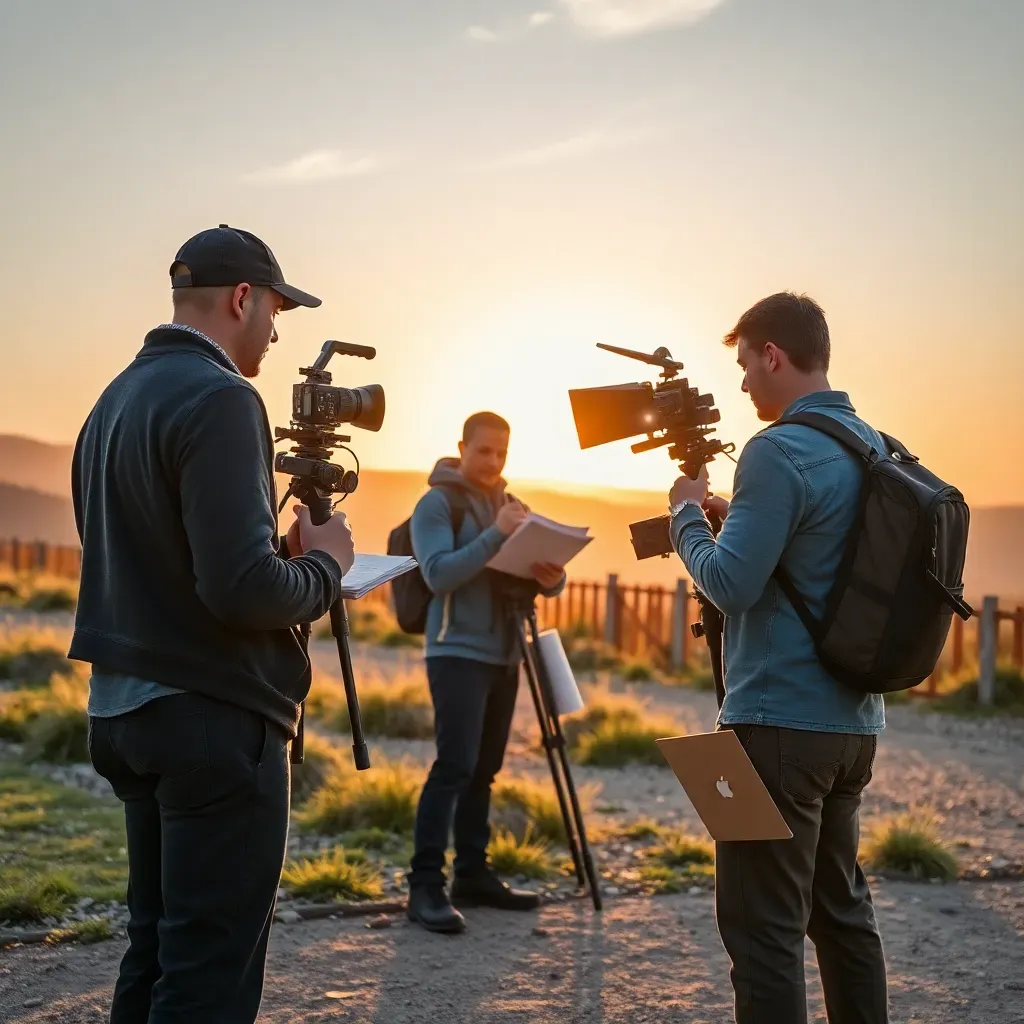
What Is a Film Fixer? The Complete Guide for Productions Filming in Spain
How production fixers make international shoots in Spain possible — from Madrid and Barcelona to the Canary Islands, Almeria, and beyond
Spain has quietly become one of the most sought-after filming destinations in Europe. The role of the film fixer is central to knowing why. A fixer is a local production pro who transforms a foreign crew's ambitions into a functioning shoot on the ground. In Spain, that means handling a layered system of city ayuntamientos for permits, unlocking tax deductions that range from 30% at the national level to an extraordinary 50% in the Canary Islands, and connecting global teams with a domestic production infrastructure that has expanded a lot in recent years. Whether a crew is staging a desert standoff in Almeria — the same landscapes Sergio Leone made iconic — or threading through the narrow streets of Seville's Alcazar where Game of Thrones filmed its Dornish palaces, the fixer is the person who makes it all happen without the production grinding to a halt. This guide explains what fixers do, why Spain specifically demands one, how they differ from other production roles, and how to choose the right partner for your shoot.
As Fixers in Spain, we bring local expertise to international productions filming in Spain. Our team's deep knowledge of local regulations, crew networks, and production infrastructure ensures your project runs smoothly from pre-production through delivery.
ACT 01
What Is a Fixer?
The Local Expert Behind Every International Shoot in Spain
A film fixer is a local production pro who manages the logistical, administrative, and cultural complexities of filming in a foreign country. The term migrated into cinema from journalism, where correspondents relied on local contacts to arrange access in unfamiliar areas. In Spain's production scene, the fixer role has grown into something specific multifaceted. The country's decentralized government structure means filming rules, permit authorities, and even language can shift a lot between autonomous communities — what works in Catalonia may not apply in Andalusia, and neither framework tells you much about the Canary Islands. A competent fixer holds all of these variables in working memory at once.
- Fixers carry deep, today's knowledge of Spain's regional rules, location access, and production infrastructure
- They function as the production's local representative with government bodies, vendors, property owners, and communities
- Most production fixers in Spain operate fluently in Spanish and English, with many also speaking Catalan, Basque, or other regional languages
- The role spans from person freelance coordinators to registered [shoot service firms](/services/) with full operational infrastructure
Why the Term Stuck in Spain's Film Industry
Global shoots arriving in Spain in the 1960s — drawn by cheap labor, dramatic scenery, and obliging dictatorial authorities — relied on local intermediaries they simply called fixers. The term persisted even as the role professionalized a lot. Today's Spanish fixer bears little resemblance to those early intermediaries. They manage six-figure local budgets, set up with ICAA (the national film authority), negotiate with heritage bodies like Patrimonio Nacional for access to royal palaces and historic sites, and structure shoots to boost Spain's generous tax incentive framework. But the name endures because the core function stays the same: taking what seems impossible for a foreign crew and making it work.
Individual Fixer vs Production Service Company
A person fixer is a single skilled local who handles planning, translations, and problem-solving on a freelance basis. A shoot service firm is a registered Spanish business offering the full operational stack: crew hiring, gear sourcing, accounting in euros, local insurance, permit planning, and production management under one roof. In Spain specifically, working with a registered firm matters for tax incentive eligibility — the 30% deduction needs qualifying expenditure through well structured local entities. Many person fixers have built firms around themselves as the Spanish market has matured. But the distinction matters when your shoot needs to claim incentives.
ACT 02
What Does a Fixer Do?
The Full Scope of a Fixer's Work in Spain
The range of responsibilities a production fixer carries in Spain is wider than most global producers expect. Spain's administrative structure — with national, autonomous community, provincial, and city layers of governance — means that a task as apparently simple as a filming permit can need buy-in with many authorities operating on different timelines and with different needs.
- [Filming permits](/services/pre-production/film-permit-acquisition/) — handling ayuntamiento-level applications, Patrimonio Nacional approvals for royal and heritage sites, and regional film commission planning
- [Crew sourcing](/services/film-crew/) — accessing Spain's deep talent pool across Madrid, Barcelona, and regional production hubs. This includes pros for desert, marine, and high-altitude work
- Gear — arranging rental from Spanish vendors, setting up customs for imported gear under ATA Carnet or short-term import, and sourcing specialized rigs for Spain's varied terrain
- [Location scouting](/services/pre-production/location-scouting-services/) — identifying locations that match creative briefs while being in use filmable, from Almeria's tabernas desert to Barcelona's modernist build style and the volcanic landscapes of the Canary Islands
- Government and community liaison — managing relationships with city police, traffic authorities, neighborhood associations, and the at times complex dynamics of filming in residential areas
- Translation and cultural mediation — bridging not just the Spanish-English language gap but regional cultural nuances, the rhythm of Spanish business hours including the afternoon break, and local expectations around community buy-in
- Transport and lodging — organizing car fleets, driver logistics across Spain's great motorway network, hotel blocks, and daily crew movement across what is Europe's second-largest country by area
- Tax incentive structuring — advising on how to boost Spain's 30% base deduction (or up to 50% in the Canary Islands and 35% in Navarra) by well structuring local expenditure and records
- Emergency problem-solving — handling everything from sudden weather events in mountain locations to last-minute permit complications when a city festival takes priority over your shooting schedule
Pre-Production: The Groundwork That Determines Everything
Before a single frame is shot, the fixer builds the local infrastructure your production will depend on. In Spain, this starts with permit research — a process tricky by the fact that each municipality issues its own permits, regional film commissions give facilitation but not authority, and certain types of location (royal palaces, UNESCO sites, military installations, national parks) involve fully separate approval chains. The fixer researches all of these threads, files applications to the correct bodies, and manages the timelines. At once, they source crew from Spain's increasingly sophisticated talent pool — Madrid and Barcelona both have thriving production communities. But shoots in Andalusia, the Canary Islands, or northern Spain need tapping regional networks. Gear sourcing, transport planning, and budget construction happen in parallel, with the fixer building cost projections that account for Spanish market rates global producers would not know.
Production: Holding It Together on the Ground
During filming, the fixer becomes the production's operational nerve center locally. In Spain, this means constant liaison with city police setting up street closures, managing relationships with location owners who may have second thoughts after seeing the scale of gear arriving, and handling the daily logistics of crew meals, transport, and schedule adjustments. Spanish production culture has its own rhythms — call times, meal breaks, and union expectations differ from American or Northern European norms — and the fixer translates these expectations in both directions. When problems arise, and they always do, the fixer draws on relationships and local knowledge that cannot be replicated by someone unfamiliar with Spanish bureaucracy and culture.
Administrative and Legal Compliance
Global shoots in Spain face a web of administrative needs: work permits for non-EU crew under Spanish immigration law, gear customs declarations, compliance with Spanish employment contracts and social security inputs for local hires, insurance meeting Spanish legal minimums, and the detailed records needed to claim the ICAA tax incentive. The fixer sets up with Spanish accountants, labor lawyers, and customs agents to make sure compliance across all of these areas. Getting any one of them wrong can be costly — either through direct penalties or through disqualification from the tax incentive that brought the production to Spain in the first place.
ACT 03
When Do You Need a Fixer?
Recognizing the Situations Where a Spanish Fixer Becomes Essential
Not each production filming in Spain needs a fixer — a Spanish crew shooting in their home city obviously does not. But for global shoots, the question is rarely whether you need one. It is how early you should engage them. Spain's combination of decentralized governance, generous but records-heavy tax incentives, and strong regional identities creates a landscape where local expertise pays for itself almost at once.
- The production is shooting in Spain without Spanish-speaking team members embedded in the core crew
- You are filming in many autonomous communities, each with distinct permit processes and film commission relationships
- The shoot involves heritage locations, royal sites, or covered natural areas needing specialized permits
- The production intends to claim Spain's 30-50% tax deduction and needs local structuring to qualify
- The timeline leaves no margin for the permit delays and logistical miscalculations that plague first-time visitors
Spain's Language and Cultural Landscape
Spain is not a single-language country. Castilian Spanish is universal. But Catalan dominates in Barcelona and the northeast, Basque is spoken in the north, and Galician prevails in the northwest. City permit offices in Catalonia may correspond primarily in Catalan. Beyond language, Spanish business culture operates on its own logic — the afternoon break stays a real factor in scheduling government interactions, relationship-building is genuinely important rather than merely polite, and the pace of bureaucratic processes reflects cultural attitudes toward hierarchy and procedure that differ a lot from Anglo-Saxon norms. A fixer who operates natively within this culture prevents the mix-ups that cost shoots days rather than hours.
Navigating Spain's Incentive Landscape
Spain's tax incentive for global shoots is one of Europe's most attractive — 30% at the base level, with the Canary Islands offering up to 50% through their ZEC (Zona Especial Canaria) regime, and Navarra giving 35%. But these incentives come with qualification needs that demand careful local structuring. Eligible expenditure must flow through well registered Spanish entities, records must meet ICAA standards, and the production must show genuine economic inputs to the Spanish industry. Productions that attempt to handle this without a fixer who knows the system risk either failing to qualify fully or structuring their spend in ways that leave major money on the table.
Multi-Region Shoots and Spain's Scale
Spain is a geographically vast and climatically varied country. A production that shoots in the Canary Islands for volcanic landscapes, moves to Almeria for desert sequences, films interiors at Secuoya Studios in Madrid, and captures period build style in Seville is effectively operating across four different regulatory environments. Each municipality issues its own permits. Each autonomous community has its own film commission with its own facilitation processes. Gear availability, crew pools, and vendor relationships differ by region. Managing a multi-region shoot without a fixer who has networks across all of these areas turns a complex production into a chaotic one.
ACT 04
Fixer vs Line Producer vs Production Coordinator
Understanding Where Each Role Begins and Ends
Global shoots at times conflate these three roles. This creates confusion about who is responsible for what. In Spain's production scene, the boundaries are clear in theory but blurred in practice — specific on smaller shoots where a fixer may absorb elements of all three positions.
- A fixer gives territorial expertise — they know Spain, its systems, its people, and its quirks at a granular operational level
- A line producer manages the global shoot budgets, schedule, and delivery commitments no matter area
- A production coordinator handles administrative workflows — call sheets, travel bookings, crew communications, and forms
- On global shoots in Spain, the fixer and line producer mostly operate as complementary partners with distinct domains
The Overlap and the Distinction
A London-based line producer managing a commercial shoot in Barcelona cannot walk into the Ajuntament de Barcelona and negotiate a filming permit in Catalan. They cannot check whether a Spanish gaffer's day rate is competitive or inflated. They cannot judge whether a specific location in the Gothic Quarter will trigger noise complaints from residents who know their rights under local ordinances. The fixer fills each one of these gaps. On larger shoots — feature films and series shooting across many Spanish locations over weeks or months — the fixer works alongside the line producer in a clearly defined partnership. The line producer holds the budget and schedule. The fixer executes locally, flagging costs and risks the line producer would not otherwise see. On smaller shoots, the fixer may effectively serve as the local line producer, taking ownership of both strategy and execution under the production firm's oversight.
Choosing the Right Configuration for Spain
For a three-person documentary crew filming interviews in Madrid over four days, a fixer alone covers everything — permits, crew, transport, translation, and troubleshooting. For a mid-scale commercial shooting across Barcelona. The Canary Islands, you need a fixer managing local logistics and either a line producer or coordinator managing the cross-regional schedule. For a feature film or prestige series like the kind now shooting often at Secuoya Studios and across Andalusia, the full structure applies: line producer managing the global picture, production coordinator handling administrative workflows, and a fixer or shoot service firm running everything on the ground. The fixer's role scales fluidly — what changes is not the quality of expertise but the scope of responsibility.
ACT 05
What Does a Fixer Cost?
Pricing Realities for Production Support in Spain
Fixer costs in Spain are influenced by several interlocking factors: the region (Madrid and Barcelona command different rates from smaller markets), the length and complexity of the buy-in, the scale of crew and gear being managed, and whether the production needs a freelance coordinator or a full shoot service firm. We do not publish fixed rates because they would be misleading — a one-day permit run in Valencia bears no resemblance to a six-week multi-site feature shoot.
- Person freelance fixers in Spain mostly work on day rates that differ by experience and region
- Shoot service firms quote project-based fees covering the full scope of local production management
- For shoots claiming tax incentives, the fixer's fee is mostly eligible as qualifying local expenditure
- The cost of not having a fixer — measured in lost shooting days, failed permit applications, and forfeited tax incentives — always exceeds the fee
Day Rate vs Project Fee in the Spanish Market
A freelance fixer charging a day rate makes economic sense for small, contained shoots — a journalist needing local support in Bilbao, or a branded content team spending three days in Mallorca. For anything beyond that, a shoot service firm gives better value because they bundle planning, crew management, gear sourcing, permit handling, tax structuring, and production accounting into a single buy-in. Comparing a freelancer's day rate to a firm's project fee is comparing ingredients to a finished meal. The firm replaces many person hires you would otherwise need to find, vet, and manage separately — and they carry the insurance and legal structure that pro global shoots need.
Factors That Shape Spanish Fixer Pricing
Region matters: Madrid and Barcelona have higher cost bases than Andalusia or the Canary Islands, though the Canaries' higher incentive rate often offsets this. Length and phase coverage affect pricing — a fixer engaged for pre-production research, active production, and post-shoot wrap costs more than one hired for shoot days alone. But delivers disproportionately more value. Location complexity drives cost: filming at the Alhambra involves months of permit lead time and specialized heritage needs that a street-level commercial in the Salamanca district of Madrid does not. Gear customs planning, multi-language crew management, and tax incentive records all add scope. The right way is to share your complete project brief and receive a line-by-line quote you can interrogate in detail.
The Return on Investment
Consider a concrete scenario: a production shoots in Spain without a fixer and fails to structure its local expenditure correctly for the ICAA tax incentive. On a million-euro Spanish spend, the lost deduction alone could reach 300,000 euros — more than any fixer's fee by an order of magnitude. Even setting aside incentives, a single lost shooting day on a global shoots in Spain (crew standing idle, gear rental ticking, lodging costs burning) can exceed the fixer's entire buy-in cost. Skilled fixers do not just prevent losses. They actively create savings through vendor relationships, accurate budget work, and the operational efficiency that comes from knowing an area inside out.
ACT 06
How to Choose a Fixer
What Separates a Reliable Partner from a Risky One in Spain
The Spanish production market has grown fast, and the quality of ready fixers differs to match. Some are seasoned pros with decades of experience serving global shoots at the highest level. Others are recent entrants trading on enthusiasm rather than proven skill. Here is how to distinguish between them.
- A track record with shoots matching yours in scale, format, and complexity — documentary fixers and feature fixers develop different expertise
- Sign-ups as a Spanish firm (Sociedad Limitada or similar) with production insurance and clear contractual terms
- Set up relationships with city permit offices, regional film commissions, and the ICAA at national level
- Fluent, responsive communication in English and Spanish, with extra regional language skill where relevant
- References from recent shoots that you can check independently, not just a list of titles on a website
- Shown knowing of Spain's tax incentive system and the structuring needed to qualify
Evaluating Experience in the Spanish Market
Request a production list and examine it critically. A fixer who has managed global commercials in Barcelona may lack the permit relationships needed for a feature shoot across Andalusia. Someone skilled with documentary work in the Canary Islands may not have the crew network for a large-scale drama in Madrid. Look for experience that aligns with your production's specific demands — scale, format, geography, and type of locations. Then contact references directly. Ask about problem-solving under pressure, budget accuracy, communication quality during pre-production, and whether the referencing production encountered any surprises their fixer should have expected. The answers tell you more than any credentials document.
Verifying Professional Infrastructure
In Spain, a pro fixer or shoot service firm should be registered with the Registro Mercantil, carry production liability insurance meeting global standards, and be able to give a formal contract under Spanish law. They should produce itemized budgets denominated in euros with clear cost types, not vague estimates or round numbers. For shoots planning to claim tax incentives, the fixer should show knowing of ICAA qualification needs and ideally have a working relationship with a Spanish production accountant who handles incentive records. If a prospective fixer cannot give a registered business address, proof of insurance, or a clear contract — move on. The stakes are too high.
Assessing the Working Relationship Early
Your first interactions with a potential fixer reveal everything. Do they ask probing questions about your project — shoot dates, location types, crew needs, creative priorities — or do they quote at once based on minimal info? Do they helper local knowledge unprompted, such as flagging that your target dates coincide with Semana Santa when city permit offices close for a week? Do they push back constructively on unrealistic expectations, or agree with everything to win the job? The fixers who deliver the best outcomes are the ones who challenge your assumptions early, identify risks you had not considered, and bring local intelligence that shapes your planning for the better. Agreeable is easy. Genuinely helpful needs expertise and confidence.
ACT 07
Real-World Examples of Fixers in Action
How Production Fixers Solve the Problems That Stall Shoots in Spain
Theory only goes so far. Here are three anonymized scenarios drawn from shoots we have supported in Spain that illustrate the concrete difference a fixer makes.
- Heritage permit rescue: securing last-minute alternative access when a Patrimonio Nacional site became unavailable
- Multi-region crew mobilization: assembling specialized teams across three autonomous communities under compressed timelines
- Tax incentive salvage: restructuring a production's local spend to recover qualification for the 30% deduction after first missteps
The Heritage Site That Fell Through
A European drama had built key scenes around a specific royal palace managed by Patrimonio Nacional. Six weeks before the shoot, the site withdrew availability due to a restoration project that advanced ahead of schedule. The production had no alternative and no other contacts within Spain's heritage permit system. Our team identified three substitute locations within 48 hours — two managed by regional heritage authorities in Andalusia and one privately owned estate in Castilla-La Mancha with period-appropriate build style. We started permit applications for all three at once, arranged scout visits for the director within the week, and had a fully permitted replacement confirmed within twelve days. The production lost no scheduled shooting days. Without a fixer embedded in Spain's heritage permit network, the production would have faced a costly delay or a costly rewrite.
Assembling Crews Across Three Regions
A streaming sites's travel series needed simultaneous second-unit coverage in the Canary Islands, a primary unit in Seville, and a pickup crew in Barcelona — all within the same production week. Each location needed camera, sound, and production support drawn from local talent pools to avoid extra travel costs and per diem expenditure. Our fixer drew on crew networks built across years of multi-region production in Spain, vetting and confirming eleven crew members across three cities within four days. Gear was sourced locally in each region to cut inter-city shipping. Call sheets, tech specs, and communication protocols were standardized across all three units so that footage matched despite being shot by different teams. The production saved significantly compared to flying a single crew between locations. The local hire added to their tax incentive qualification.
Recovering a Compromised Tax Incentive
A mid-budget feature film shooting in Madrid had engaged a fixer with tight experience in tax incentive structuring. Midway through production, the producing partners realized that a substantial portion of their Spanish expenditure had been routed through entities and payment structures that would not qualify for the 30% ICAA deduction. They brought our team in to check the situation. We restructured the left local spend, redirected qualifying expenditure through well registered Spanish entities, worked with Spanish production accountants to remediate records from earlier in the shoot, and advised on extra qualifying activities that could be shifted into the Spanish production window. The result was not a full recovery — some early spending could not be retrospectively qualified — but the production ultimately claimed a meaningful deduction that would have been lost fully without intervention. The lesson was costly but clear: incentive structuring should start in pre-production, not midway through the shoot.
ACT 08
Common Questions
What is a fixer in the film industry?
A fixer in the film industry is a local production professional who coordinates international productions shooting in their country or region. They handle logistics including filming permits, crew sourcing, equipment rental, location scouting, translation, government liaison, and cultural mediation. In Spain specifically, fixers also navigate the country's decentralized permit system (each municipality issues its own permits), coordinate with regional film commissions, and structure local expenditure to qualify for Spain's 30-50% tax incentive for international productions.
What does a film fixer do in Spain?
A film fixer in Spain manages the full range of local logistics for international productions. This includes navigating permits through municipal ayuntamientos and heritage bodies like Patrimonio Nacional, sourcing crew from Madrid, Barcelona, and regional production hubs, arranging equipment rental, scouting locations across Spain's diverse landscapes, liaising with municipal police and traffic authorities, providing Spanish-English translation and cultural mediation, organizing transportation across Europe's second-largest country, structuring expenditure for ICAA tax incentive qualification, and solving the operational problems that arise during any shoot in unfamiliar territory.
How much does a fixer cost in Spain?
Fixer costs in Spain vary based on region (Madrid and Barcelona have higher rates than smaller markets), production scale, engagement duration, and scope of services. Individual fixers charge day rates while production service companies quote project-based fees. For productions claiming Spain's tax incentive, the fixer's fee typically qualifies as eligible local expenditure — meaning the effective cost is reduced by 30-50% depending on the region. The investment consistently pays for itself: a single prevented permit delay or properly structured incentive claim generates returns that far exceed the fixer's fee.
What's the difference between a fixer and a line producer?
A fixer provides territorial expertise specific to Spain — they know the permit offices, the crew networks, the vendor landscape, the cultural dynamics, and the tax incentive system. A line producer manages the overall production budget, schedule, and delivery commitments regardless of location. On international shoots in Spain, both roles typically operate in parallel: the line producer holds the global budget and schedule while the fixer handles local execution, flagging costs and risks the line producer cannot see from abroad. On smaller shoots, the fixer may absorb the line producer function locally, managing both strategy and execution under the production company's direction.
Do I need a fixer for a small shoot in Spain?
If the shoot involves permits, non-Spanish-speaking crew, or locations outside major tourist areas, yes. Even small productions benefit from a fixer when navigating Spain's municipal permit system, communicating with Spanish-speaking authorities and vendors, or operating under tight timelines. Spain's permit processes, business culture, and regional variation create friction that a fixer eliminates efficiently. The cost for supporting a small crew is modest, and a single prevented problem — a denied permit application, a location miscommunication, a missed opportunity to claim tax incentives — justifies the investment many times over.
How do I find a fixer in Spain?
Start with established production service companies registered in Spain with a verifiable track record, production insurance, and clear contractual terms. The Spain Film Commission, Madrid Film Office, Barcelona Film Commission, and Canary Islands Film can provide recommendations. Ask production companies who have filmed in Spain recently for referrals. When evaluating candidates, request an itemized quote in euros, check references from productions similar to yours in scale, confirm the fixer is registered as a Spanish business entity, and verify their understanding of ICAA tax incentive requirements. Our team provides comprehensive fixer and production services across all of Spain's autonomous communities with established relationships at every level of government.
Ready to Roll
Need a Fixer for Your Production in Spain?
Whether you are planning a feature film across Andalusia, a commercial in Barcelona, a documentary in the Canary Islands, or a series at one of Madrid's growing studio complexes, our team provides comprehensive fixer and production services across every region of Spain. We handle permits, crew, equipment, locations, tax incentive structuring, and every logistical detail so you can focus on the creative work. Contact Fixers in Spain to discuss your next project.